
Rob Swan
How Do I Rank Higher on Google Maps: A Trade Business Guide

The worst part of being buried on Google Maps is that it rarely looks like a technical problem from the owner's side. The truck is running, the phones are on, the crew is doing good work, and still the calls go quiet while a competitor with a thinner operation seems to sit in the map pack all day. In small towns, that gap gets even more frustrating because you know the work is there, you just can't seem to surface for relevant queries.
Google doesn't rank map listings by luck. It uses relevance, distance, and prominence as the core framework for local results, and that's the right lens for diagnosing why one trade business shows up while another doesn't (Google Business Profile help on local ranking). If your profile doesn't match the search well enough, if the searcher is too far away, or if your business doesn't look established enough online and offline, you lose visibility. That's why two businesses in the same town can rank differently for the exact same service term, and why your position can change from one side of town to another.
The good news is that the fix is usually practical, not mysterious. Most trade businesses need a better profile foundation, better review momentum, and a better way to measure visibility town by town instead of assuming one ranking applies everywhere.
Table of Contents
- Why Your Trade Business Is Invisible on Google Maps
- Fixing Your Google Business Profile Foundation
- Building Review Momentum That Beats Local Competitors
- Expanding Visibility Across Multiple Towns
- Cleaning Up Citations and Building Local Authority
- Prioritizing Fixes by Impact and Effort
- Your Implementation Roadmap and Next Steps
Why Your Trade Business Is Invisible on Google Maps
A rural HVAC owner usually spots the problem during a weather spike. The crew is booked, the phones should be ringing, and a competitor two towns over still sits above them for “furnace repair” or “AC repair near me.” Nothing changed in the shop that day, but Google changed what it showed, and that is enough to pull real demand away from you.
Google's local ranking model gives the reason. Relevance is whether your profile matches the query, distance is how close you are to the searcher or the location used in the search, and prominence is how well known your business is online and offline. Google also says complete and accurate business information helps connect a profile to a search, which is why category choice, services, and current details matter so much.
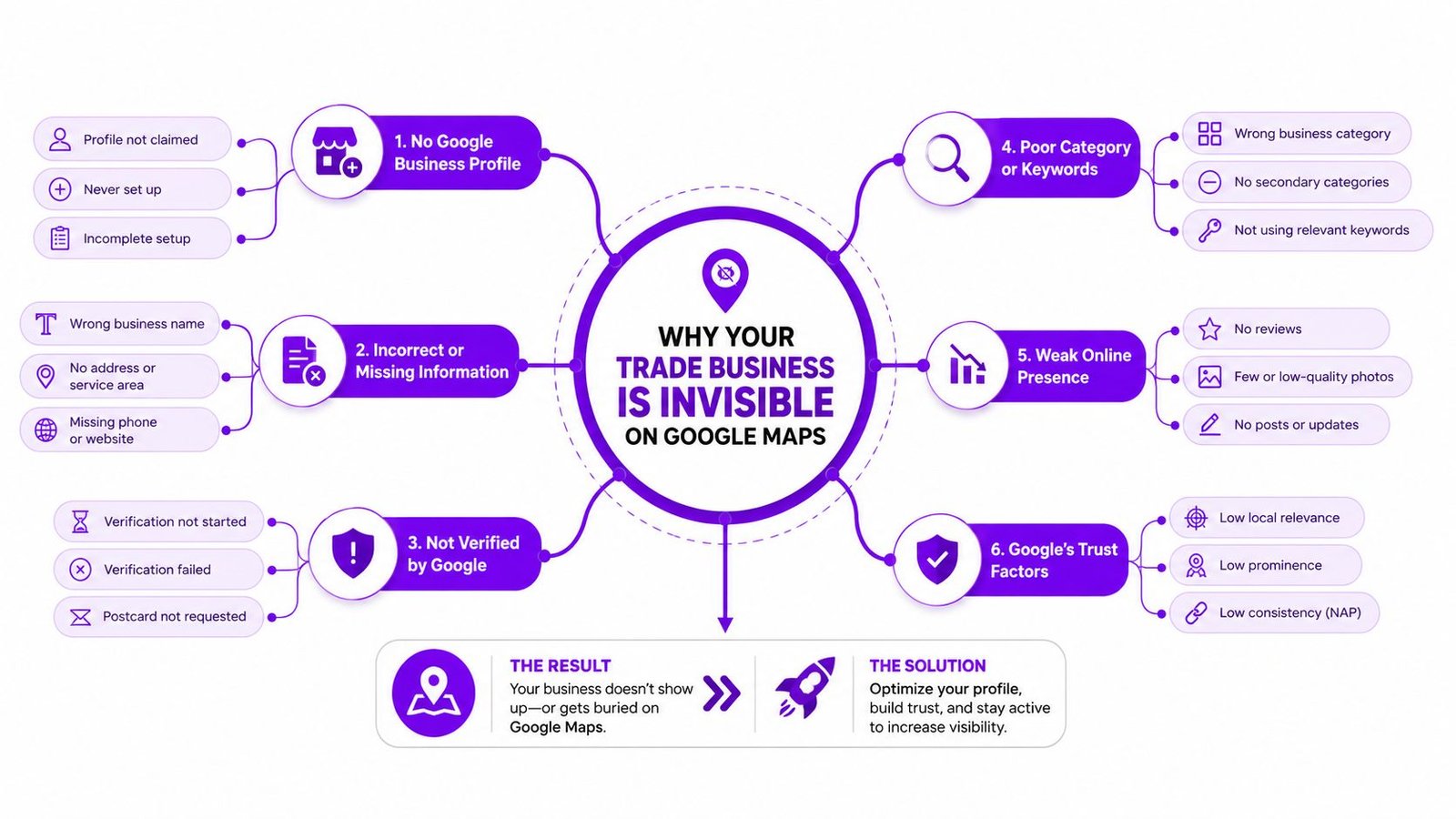
Why the same town still shows different results
Map rankings are not fixed across a whole city or county. They shift by exact location, device, and search intent, so the result a homeowner sees from downtown will not always match the result someone sees from a few miles out on a county road. That is normal behavior, not a glitch.
Practical rule: if you only check your own listing from your office, you are usually checking the easiest version of the search, not the one your customers see.
That is why the “how do I rank higher on Google Maps” question has to be answered with a matching process, not a shortcut. Google first checks whether the profile fits the search, then whether the business is close enough, then whether the business has enough authority signals to deserve visibility. A thin profile cannot fake relevance, and a strong brand will not fully overcome a poor service-area setup.
The internal audit usually starts with one blunt question, why is the competitor more visible in the exact search you care about? If you want a closer look at that kind of local competition pressure, this local visibility breakdown for trade businesses is a useful companion read.
Fixing Your Google Business Profile Foundation
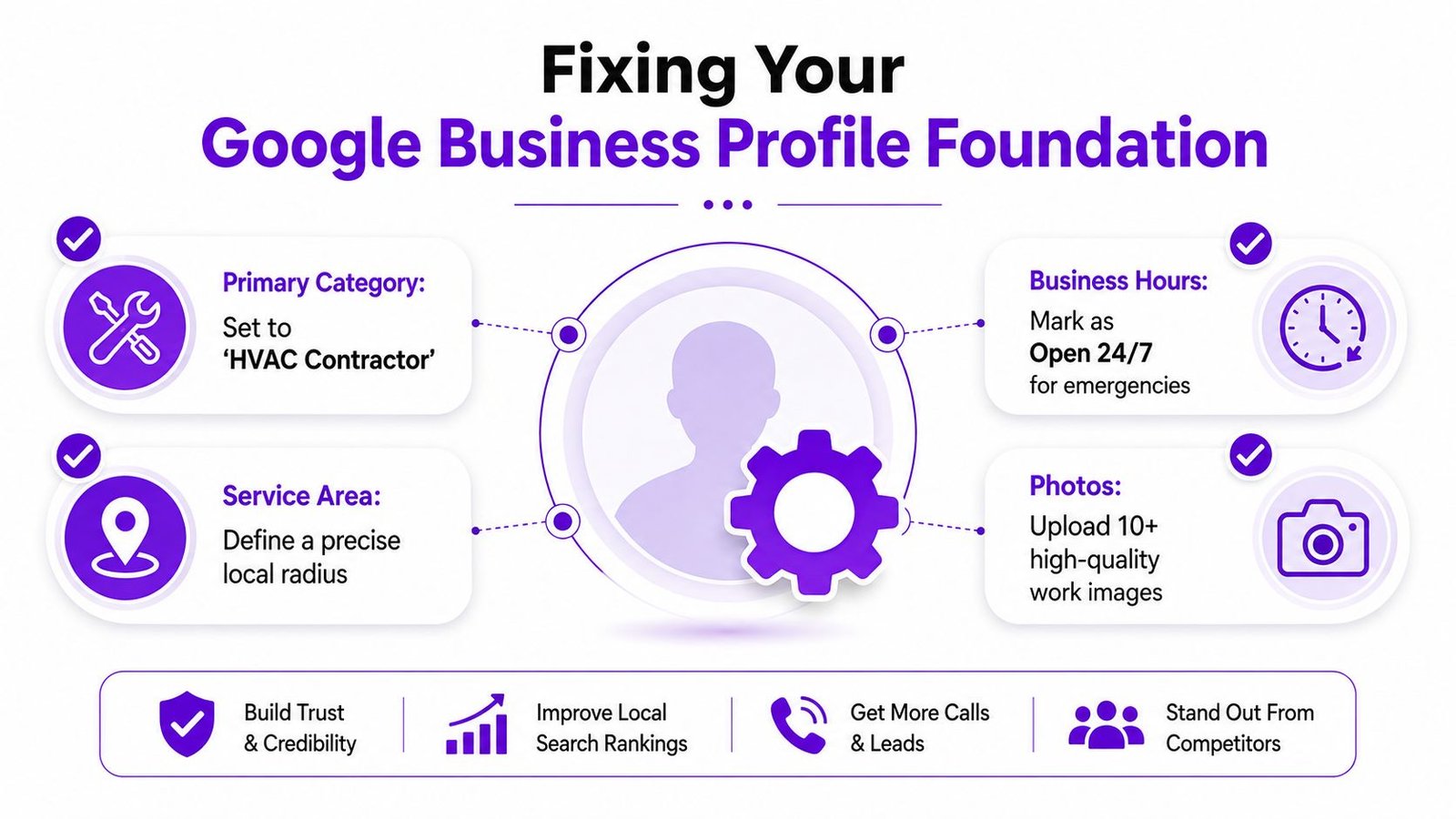
A weak Google Business Profile is often the fastest thing to fix, and it is also where many trade businesses trip up first. The profile has to tell Google exactly what you do, where you serve, and when you are available. If that information is vague, incomplete, or inconsistent, Google has less confidence in showing you for high-intent searches.
Start with category and services
The primary category functions as a relevance signal rather than a branding choice. An HVAC company should usually choose the most specific HVAC-related category available, not a generic “contractor” label, because Google needs help understanding whether you are a heating and cooling specialist, a plumbing company, or a broad general trades business. The same logic applies to plumbing, electrical, and roofing profiles.
Service listings matter just as much. If you want visibility for repair, install, and maintenance searches, those services need to be filled in clearly and specifically, not left as thin placeholders. A profile that names the work in detail gives Google more context for matching searches like furnace repair, water heater installation, or panel upgrade work.
Fill the profile completely and keep it current
Independent local SEO guidance keeps pointing to Google Business Profile completeness, category selection, and reviews as the practical levers that matter most. One common baseline recommendation is adding 10 to 15 high-quality photos and fully completing the profile so the business looks active and legitimate (local SEO guidance on Google Maps ranking factors). Another early credibility step often recommended is earning at least five new customer reviews sooner rather than later.
Hours deserve more attention than they usually get. Seasonal shifts, emergency coverage, holiday closures, and after-hours availability all affect trust, because a homeowner who shows up to a closed business will not give Google much credit for the listing. If your trade business takes emergency calls, the hours need to reflect that reality. If you have a service area rather than a customer-facing storefront, the profile setup needs to match that too.
A profile that is complete, specific, and current beats a prettier profile with missing fundamentals.
The cleanest way to approach the foundation is simple. Fill every field, use the most accurate trade category, list the actual services you sell, and make the photo set feel like a real operating business. If your profile is thin or mismatched, start there before spending energy on anything else. For a closer look at the configuration mistakes that suppress visibility, review this Google Business Profile problem checklist.
The hard part is not adding fields, it is matching the profile to how a rural or small-town trade business works. A company that covers several towns needs the profile to reflect those service-area realities instead of pretending every search happens from one central office. If the category, services, hours, and photos do not line up with real operations, Google sees a weaker local fit.
Building Review Momentum That Beats Local Competitors
A lot of owners fixate on star rating and ignore the rest of the review profile. That is a mistake. Google pays attention to reputation and activity together, so review velocity, recency, and total count all matter at the same time, especially in small towns where two or three businesses are close on everything else.
Benchmark the whole review profile, not just the star rating
A business can have a decent rating and still look inactive. If the newest review is old, the profile can feel stale even when the average score looks fine. That is why review momentum matters, because it shows Google and customers that people are still hiring the business now.
Independent local SEO guidance points to the same pattern, keep review activity ongoing, ask after service, respond quickly, and keep fresh reviews coming instead of relying on one burst. For a policy-aware view of what counts as safe review collection, use the Google review policy reference for 2026. One early benchmark often used is to secure five new customer reviews before expecting stronger credibility in the map pack.
Build a system your technicians can use
The best review process is boring in the best way. The technician asks on-site after the work is done, the office sends a text message or follow-up email with the review link, and the team responds to every review quickly. That routine is easier to keep than a marketing push that depends on memory.
Practical rule: ask while the customer is still relieved the job is finished, because that is when the review request has the best chance of landing.
Trade businesses usually do well with three simple mechanics.
- Ask at the right moment: right after a successful service call, when the customer has a fresh positive experience.
- Make the link easy: do not make customers hunt for the review button.
- Respond to every review: positive or negative, because silence signals neglect.
The big mistake is treating reviews like a campaign. Campaigns end. Momentum compounds only when asking becomes part of the close-out process for every job.
Expanding Visibility Across Multiple Towns
Multi-town trade businesses run into a frustrating pattern. The profile shows up in the home town, then disappears in the next one, even though the crew works there every week. That's usually not a mystery in the profile, it's a distance and service-area problem.
Use a town-by-town service grid
The cleanest way to measure this is with a town-by-town service grid. List the towns you serve, then check the map pack for the same priority terms from each one, such as plumber near me, furnace repair, roof repair, or electrical contractor. The goal is not to guess where you rank, it's to see which town, query, and service combination is weak.
That matters because Google's distance factor is real. You can't move the building, but you can make the service-area setup more realistic and avoid promising coverage you can't support. A service-area business that overextends into faraway towns often creates weak signals instead of stronger ones.
Separate proximity problems from prominence problems
Some towns will be hard because you're farther away. In those cases, prominence signals can help, but they don't erase distance. Other towns will be weak because the profile is thin, the category is wrong, or the reviews are too quiet. Those are fixable faster.
Here's the useful distinction.
| Situation | Likely issue | What to check first |
|---|---|---|
| Strong in home town, weak in the next town over | Distance pressure | Service-area realism and map-pack positions by town |
| Weak everywhere | Relevance problem | Category, services, and profile completeness |
| Good profile, poor visibility in multiple towns | Prominence gap | Reviews, citations, and local authority signals |
For HVAC companies, seasonal intent makes the grid even more important. A heatwave doesn't create one search pattern for the whole region, and a cold snap doesn't either. Your visibility can shift from town to town as people search in different ways, so checking only one keyword from one location gives you a false sense of performance.
Cleaning Up Citations and Building Local Authority
Citations still matter, but not the way they used to. Years ago, trade businesses could lean hard on directory listings and expect that alone to move rankings. Now citations support the profile, they don't replace it. The modern job is consistency, not volume for its own sake.
Standardize NAP before you chase more links
NAP means Name, Address, and Phone. If those details vary across listings, Google gets mixed signals about whether the business data is reliable. The variations that cause trouble are often small, like suite and unit formatting, abbreviations, or a slightly different phone number on one directory.
A practical audit starts with the major platforms, then moves to the directories that matter in your trade niche and market. Exact formatting matters more than a long directory list stuffed with weak profiles. Consistent NAP across the core listings reinforces the prominence signal and makes the business look easier for Google to trust.
Build authority where your community already pays attention
Local authority doesn't have to mean a giant backlink campaign. It can come from relevant mentions, local partnerships, chamber listings, sponsor pages, or trade associations that fit the business. A roofing company with a credible local sponsor page and a stable citation footprint usually looks more legitimate than one with dozens of random directory links.
Keep the citation work tight, accurate, and locally relevant. A smaller clean set usually beats a larger messy set.
The historical shift matters here. Google Maps visibility now leans much more on profile quality, reviews, and engagement inside Google's ecosystem than it did in older citation-heavy playbooks. That doesn't make citations useless. It makes them supporting proof, not the main event.
Prioritizing Fixes by Impact and Effort
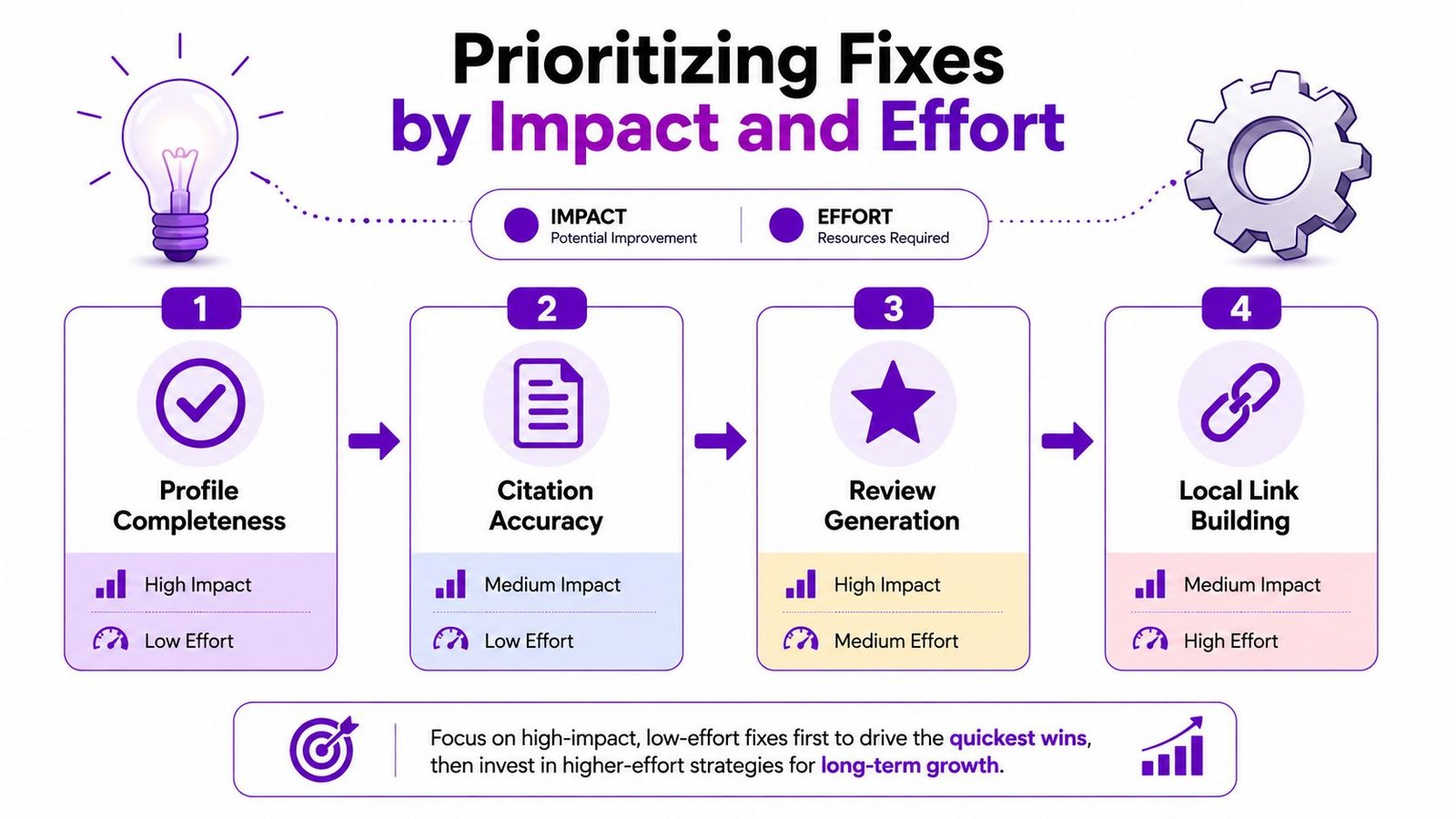
The biggest local SEO mistake is doing work in the wrong order. I still see owners jump into citation cleanup before fixing category mismatches, or spend weeks on blog content while the profile is missing services and reviews are stale. That's backward.
Fix the bottleneck first
The right order is usually profile completeness, then citation accuracy, then review generation, then local link building. That sequence lines up with how much each item tends to affect relevance, prominence, and trust, while also respecting effort. A wrong category or missing service field can suppress visibility faster than a weak backlink profile can help it.
A simple decision rule works well in the field.
- If the profile is incomplete, fix that first.
- If the NAP is inconsistent, clean that up next.
- If reviews are flat, build a steady ask process.
- If everything above is in order, then pursue local authority signals.
Match the fix to the town and query
Not every town needs the same work. A business that ranks fine in its home town but fades in a nearby area may have a distance problem more than a reputation problem. A business that's weak everywhere usually needs relevance and foundation work before anything else.
That's why the most useful local SEO decisions are boring and specific. They're not about chasing the latest tactic. They're about asking which signal Google is missing for this town, this service, and this search. Once you know that, the order of operations stops being guesswork.
Your Implementation Roadmap and Next Steps
Start with the fixes that can be done in one sitting. That means tightening the primary category, filling missing services, checking hours, and cleaning up the most obvious profile gaps. If the profile is obviously incomplete, there's no reason to wait.
Within the first week, put a review system in place. Train the technician or office staff to ask after service, send the review link automatically, and keep responses moving. From there, spend the next month cleaning citations and standardizing NAP across the core listings that matter most in your market.
After that, begin checking rankings town by town, not just from your office. Track the same repair, install, and maintenance terms from the places you serve, because that's where proximity pressure shows up first. When rankings plateau, the plateau usually tells you which signal needs another push.
If you want help, use a structured diagnostic that reviews rankings, reviews, citations, and competitors together, then translates the findings into plain English. That kind of visibility check is worth it when you're stuck in a specific town, losing the same keyword over and over, or trying to understand whether the problem is relevance, distance, or prominence.
If you want a fix-first plan built for trade businesses in smaller towns, Rural Ranking Experts can help you see what's suppressing your Google Maps visibility and what to do next. Visit Rural Ranking Experts to request a visibility snapshot and get a plain-English roadmap for stronger map pack rankings.
Written with Outrank
Leave a Reply