
Rob Swan
Google Business Profile Optimization Service: Buyer’s Guide
The first sign is usually boring, not dramatic. Calls slow down, the inbox gets quieter, and the owner starts asking whether the website is broken, whether ads are underperforming, or whether the market just cooled off. In a lot of local service businesses, the problem is simpler, the Google Business Profile has gone stale, and nobody inside the company has time to fix it properly.
That's where a google business profile optimization service enters the picture. For a trade owner, it can be the difference between a profile that just exists and one that captures demand. For a marketing lead, it can be the outsource line item that prevents the team from drowning in review replies, category cleanup, photos, hours, services, and town-by-town visibility work. For an agency owner, it can be a resale product with real margin, if the contract is sane and the delivery partner can prove they know what they're doing.
This buyer's guide is written for people who need to decide whether to buy the service, resell it, or walk away from a bad offer. It focuses on what matters in the contract, what the resale math should look like, and how to tell whether a white-label partner is worth the markup. If you're tired of vague promises and “we'll handle your GBP” pitches, use this as your filter. For common profile issues, a helpful starting point is this breakdown of Google Business Profile problems.
Table of Contents
- When the Phone Stops Ringing and GBP Enters the Picture
- Why GBP Optimization Matters at Scale in 2026
- Three Common Service Models Compared
- White-Label Tiers and the Margin Math Behind Them
- Contract Clauses That Decide Whether the Partnership Works
- Service-Area Realism and Rural Trade Specifics
- Which Model to Pick and When to Walk Away
When the Phone Stops Ringing and GBP Enters the Picture
The contractor usually doesn't wake up and decide to buy a profile service. The trigger is uglier than that. Maybe the trucks are still busy, but the map views have gone soft. Maybe the office manager says the calls from Google are down. Maybe an agency account manager realizes the client keeps asking for “just one more GBP update,” and the work has become a permanent distraction.
That's the audience for a google business profile optimization service. It's for the HVAC owner who needs more emergency calls, the agency owner who wants to resell a repeatable local product, and the in-house marketer who needs a system instead of a stack of manual tasks. The profile isn't a niche listing anymore, it's the front door for local intent.
Google's own guidance says Maps and the Local Pack rely mainly on relevance, distance, and prominence, and it recommends complete, current profile information, specific categories, and fresh hours, descriptions, and photos as practical support for those signals Google Business Profile help. That means the buyer shouldn't ask, “Do you do GBP?” The better question is, “What exactly do you change, how do you measure it, and what do you own when the contract ends?”
What this guide helps you judge
You should leave with a clear way to compare vendors, not just price tags. Some providers sell a one-time cleanup, some sell monthly management, and some sell white-label delivery to agencies that want margin without hiring a specialist. Those are very different products, and they should not be bought under the same assumptions.
You should also know where the weak spots are. If the vendor can't explain methodology, won't define reporting cadence, or hides behind generic “local SEO” language, that's a problem. A good partner talks in terms of categories, service areas, reviews, photos, completeness, and measurable map visibility, not fluff.
Why GBP Optimization Matters at Scale in 2026
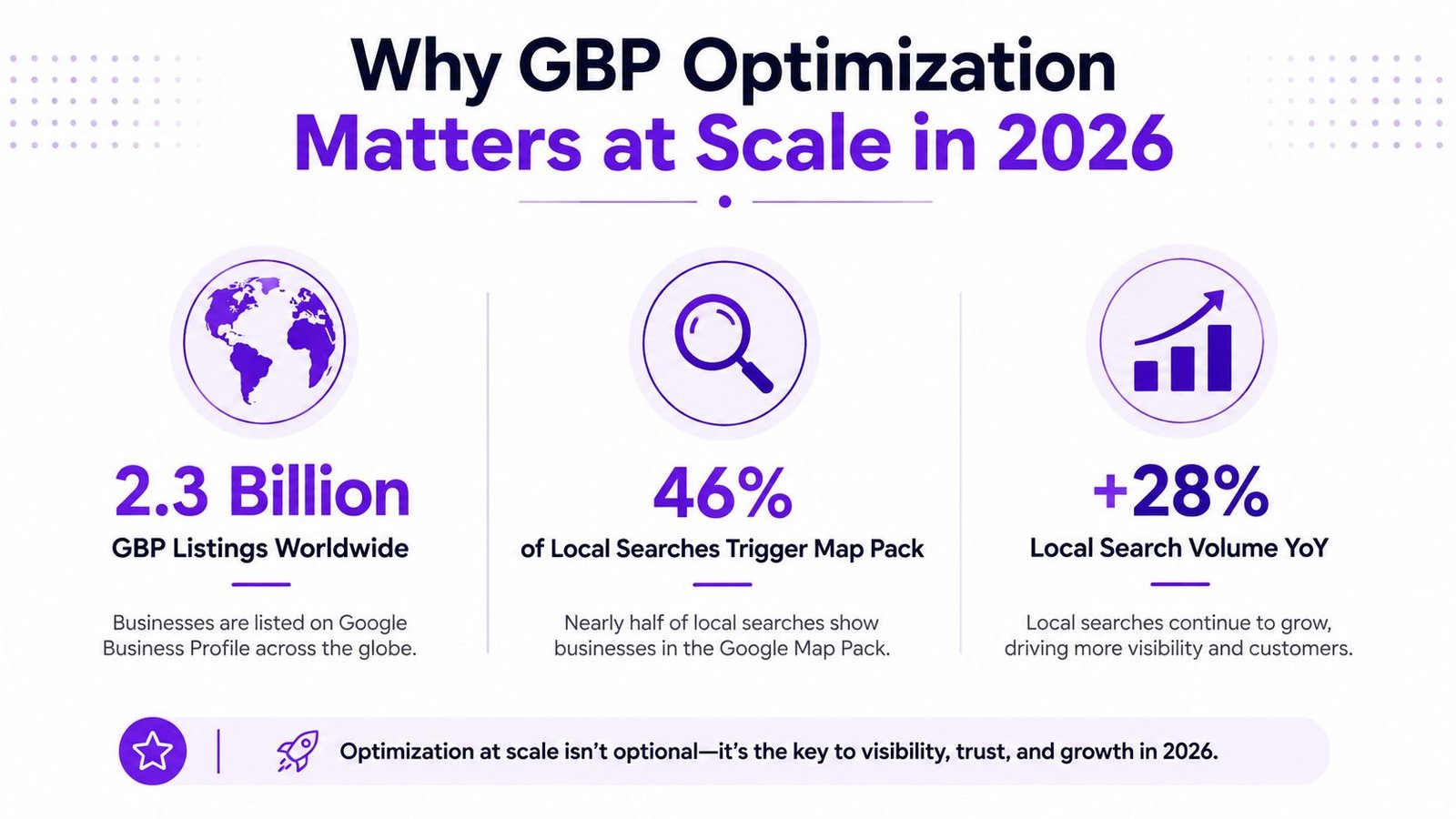
Scale is the whole argument for this service. One 2026 industry compilation says there are more than 200 million businesses with Google Business Profile listings globally, that 76% were verified in 2025, and that the Map Pack appears in 93% of local searches industry compilation. It also reports that the average SMB receives 1,009 GBP searches per month, including 781 discovery views and 228 direct branded views industry compilation. That is a heavy stream of local demand, not a side project.
For a buyer, the takeaway is blunt. A profile that is incomplete or poorly maintained underperforms inside a discovery layer that already gets steady traffic. If a competitor has fuller information, stronger review momentum, and better photos, they will usually take more of those monthly opportunities.
What quality changes actually buy you
The same 2026 compilation says a complete GBP profile earns 7x more clicks than an incomplete one, correct primary and secondary category selection is associated with 17% stronger local visibility, and businesses with photos get 30–50% more profile views industry compilation. Listings with 10+ photos can generate up to 2x more customer actions industry compilation. Those are not vanity metrics. They point to calls, direction requests, and website visits.
Independent trend data in that same compilation says GBP Maps views increased 61% year over year, while Google Search views grew 28% industry compilation. The practical point is simple, local visibility is getting more crowded. An agency or operator who buys optimization without a measurement plan is paying for activity, not outcome.
Benchmarks to demand before you sign
A vendor should be willing to be measured against these outcomes:
- Profile completeness and category fit.
- Photo freshness and posting activity.
- Review momentum and response handling.
- Town-by-town visibility, not one averaged position.
If they cannot speak clearly about those areas, they are not selling optimization. They are selling comfort.
Three Common Service Models Compared
A buyer looking at google business profile optimization service usually sees three packaging choices. One is a fixed-fee diagnostic with optional implementation. Another is a monthly per-location retainer. The third is a performance-based or rev-share arrangement. Each can work, but each shifts risk in a different direction.
| Model | Typical Price | Engagement | Best For |
|---|---|---|---|
| Diagnostic plus implementation | Project-based | Short, defined, often one cleanup plus a roadmap | Owners who want clarity before committing |
| Monthly per-location retainer | Ongoing monthly fee | Continuous management and updates | Agencies and brands that need predictable upkeep |
| Performance-based or rev-share | Variable, tied to output or revenue | Flexible, but harder to forecast | Buyers with mature tracking and a long runway |
Diagnostics are the easiest entry point because they reduce friction. You get a review of the profile, categories, photos, hours, reviews, and local visibility issues, then decide whether to implement in-house or outsource the fixes. The weak spot is simple, if the client or agency does not act on the recommendations, the value stops at the memo.
Retainers fit ongoing management better than any other model. They make sense when the profile needs regular posts, review handling, holiday hours updates, photos, and service changes. The risk is scope creep. If the contract does not spell out exactly what “management” includes, you end up paying for a promise and fighting over every extra task.
Performance deals look tidy on paper, but they are the hardest to control. Cash flow becomes uneven, attribution gets messy, and both sides start challenging the measurement method as soon as results vary by town or keyword. I would only use this model if the tracking is already mature and the vendor is willing to be audited.
Practical rule: if the proposal cannot tell you what happens on day one, month one, and month six, do not buy it.
Walk away from any model that hides delivery behind vague language, locks you into a long commitment without review points, or claims it can “guarantee rankings.” Google does not sell guarantees, and neither should the reseller.
White-Label Tiers and the Margin Math Behind Them
Agencies get sloppy here because the packaging looks easy. They buy a tool, mark it up, and call it a service. That only works if the contract and the pricing model cover support time, reporting demands, and the client’s expectation that someone can answer strategy questions, not just hand over login access.
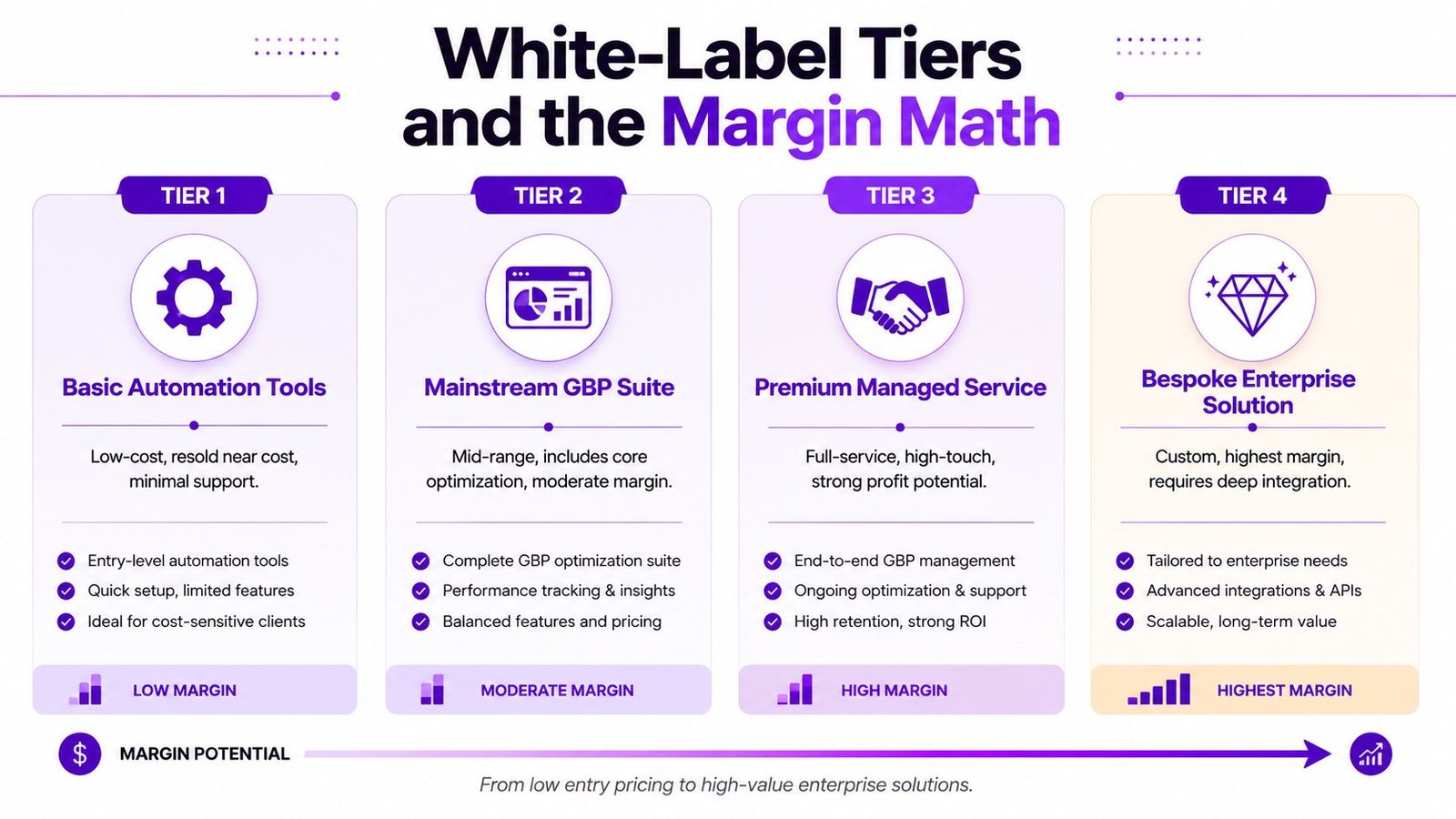
The tooling market comparison in the brief shows lightweight automation can start around $9/month, mainstream GBP management often lands around $30 to $60 per location per month, and enterprise listing suites or review platforms can reach $199+ per year or much higher custom pricing tool market comparison. That spread is where reseller economics live. Cheap tools can produce margin, but they rarely carry much service depth.
The four tiers agencies buy
Tier 1, basic automation tools.
These are near-cost resale products. The markup can look attractive until support requests start eating the spread. If you are only bundling software access and a thin setup layer, keep the markup modest and the promise narrower.
Tier 2, mainstream GBP suites.
This is the cleanest middle ground for many agencies. The platform covers core profile work, and the service can handle regular optimization without turning into a custom project every month. The margin stays healthy when onboarding is tight and the scope stays disciplined.
Tier 3, premium managed service.
Here you are selling the service, not just the platform. The economics improve when the partner handles implementation, review workflows, and reporting, but only if the minimum commitment is long enough to cover labor. If the contract is loose, this tier turns into unpaid consulting.
Tier 4, bespoke enterprise solution.
This is the custom lane for multi-location operators that need integration, governance, and heavier reporting. The margin can be strong because the work is specialized, but the sales cycle and onboarding load are heavier too. Agencies should price for that complexity instead of pretending it is just a bigger version of Tier 2.
If you are reselling a $9/month tool as if it were a full service, the margin looks fine until the first client wants strategy calls, reporting interpretation, and emergency fixes.
A serious agency should ask for wholesale price, included deliverables, minimum commitment, and support limits before signing anything. If the vendor will not separate software-driven tasks from human-delivered work, you are buying ambiguity, not a product.
Contract Clauses That Decide Whether the Partnership Works

The contract decides whether the partnership is profitable or a time sink. That’s not legal drama, it’s basic operations. The details around access, ownership, cadence, and termination matter more than the sales deck.
Exclusivity is the first thing I’d question. If a partner wants exclusivity by market or vertical, they need to earn it with proven process and clear deliverables. If they can’t explain why they need it, don’t give it away.
IP ownership matters more than most agencies admit. Reports, templates, onboarding docs, and custom workflows should be defined in writing, especially if you plan to keep selling the service after the relationship ends. If the vendor owns all the usable materials, you may be trapped even when the partnership goes south.
For review handling, Google’s review policy guidance should be part of the operating reality, not a footnote. Any partner who treats reviews as a spam game instead of a policy-sensitive workflow is creating risk for your client and for your agency.
Clauses that need a red flag check
- Exclusivity. Red flag, the vendor wants broad exclusivity with no performance standard. Better alternative, narrow exclusivity tied to clear scope and review periods.
- White-label scope of work. Red flag, “everything GBP-related” with no task list. Better alternative, named deliverables, reporting cadence, and a hard support ceiling.
- Data access and portability. Red flag, the partner controls all logs and won’t export cleanly. Better alternative, shared access and export rights for reports, assets, and account data.
- Termination and refund language. Red flag, no exit path before renewal. Better alternative, written notice periods and a clean handoff process.
- Reporting cadence. Red flag, ad hoc updates only. Better alternative, fixed monthly reporting with the metrics defined in advance.
If there’s one clause that causes the most pain, it’s the handoff language. A partner can be fine while you’re paying them and a nightmare the minute the relationship ends. Define what gets transferred, in what format, and by when.
Service-Area Realism and Rural Trade Specifics
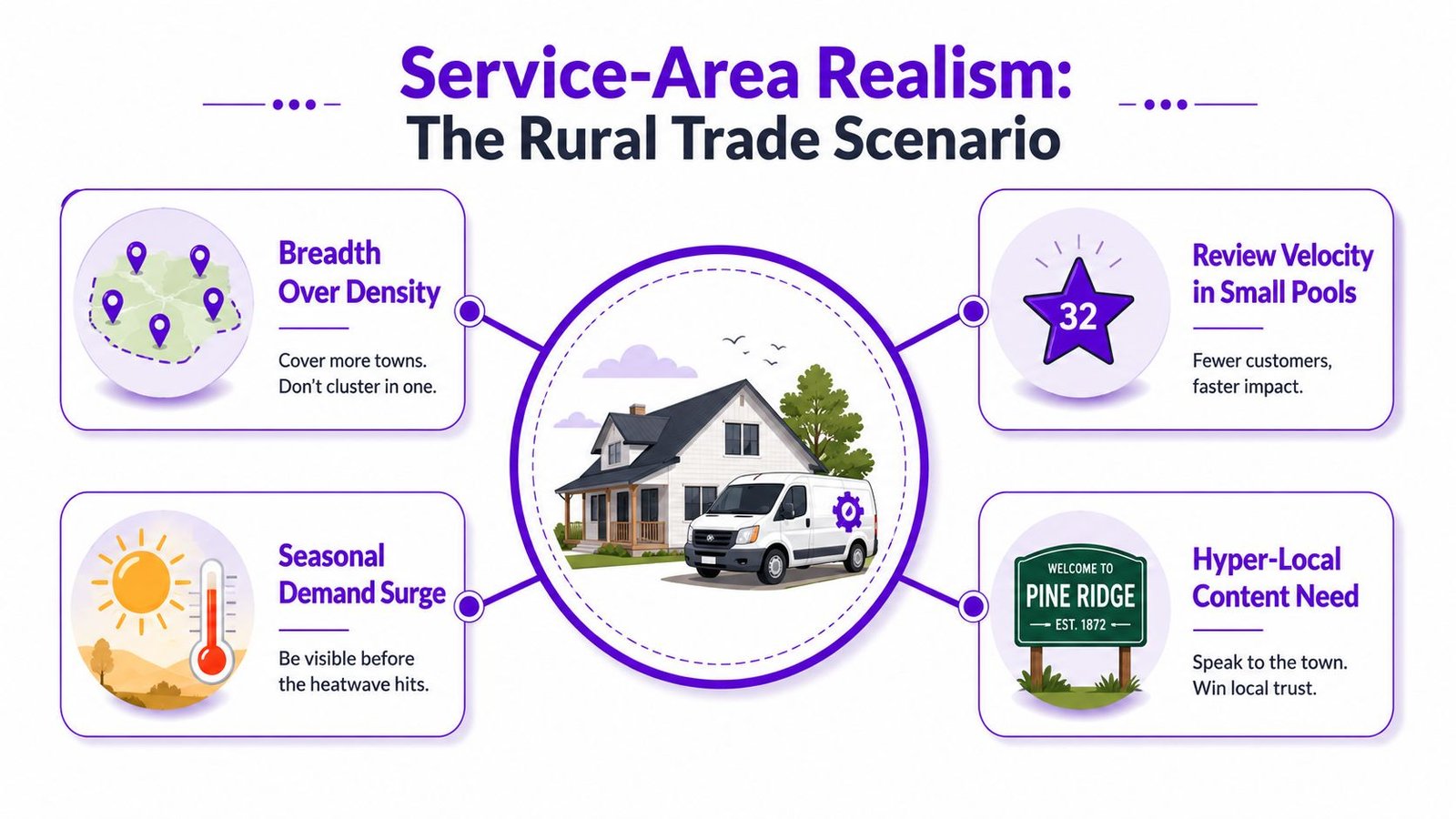
On a July afternoon, an HVAC contractor covering five small towns is not thinking about theory. The office is getting hammered with heatwave calls, the install crew is booked, and the owner wants to know why one town is getting map-pack visibility while another one barely shows up. That’s where a lot of generic GBP advice falls apart.
Google’s guidance says service areas are set in the profile editor, but it doesn’t promise visibility in every town you list. Independent local-search guidance also says service areas should be specific but realistic, which is the right standard for rural contractors who work across a cluster of towns. The question isn’t how many towns you can type into the dashboard, it’s which towns you can serve without creating operational nonsense.
What matters in a rural multi-town market
The first filter is travel reality. If a town is technically in your service area but you rarely take jobs there, don’t build your optimization plan around it. The second filter is review momentum. In small towns, a handful of recent reviews can change trust fast because the pool is small and local memory is long.
The third filter is seasonal demand. HVAC, plumbing, electrical, and roofing all get weird during spikes. A profile that looks fine in a quiet month can become irrelevant when search demand surges and competitors are posting, reviewing, and refreshing their profiles faster.
That’s why town-by-town visibility checks matter more than generalized “local SEO” claims. A contractor can look healthy on average and still be invisible in two of the four towns that generate margin. If a vendor can’t show you that variation, they’re not looking closely enough.
For broader rural strategy considerations, Rural Ranking Experts on service-area optimization is one of the few pieces of guidance that treats the problem as a real operating issue rather than a copy-and-paste checklist.
Which Model to Pick and When to Walk Away
If you’re a small agency with fewer than ten clients, start with a mainstream per-location suite. You need repeatability more than customization, and you don’t want a vendor relationship that forces a lot of manual babysitting. Keep the scope tight and make sure the reporting is understandable by someone who isn’t deep in local search every day.
If you’re a mid-sized agency serving trade verticals, add a diagnostic-led boutique partner into the mix. That gives you a real reset option when a client’s profile is messy, the categories are wrong, or the review base is weak. It also gives you a better story than “we turned it on and hope it works.”
If you’re an enterprise reseller, negotiate custom enterprise terms. At that point, your questions should shift from “what does the tool do” to “who owns the workflow, who handles escalation, and how does the handoff work across locations.” You’re no longer buying convenience, you’re buying operational control.
Walk away from vendors who refuse to share methodology, lock you into annual contracts without a review point, or claim they can guarantee rankings. Walk away from anyone who can’t separate software from labor. And walk away from partners who won’t put service scope, IP ownership, and exit rights in writing.
Buy the partner who explains the work, not the one who hides it behind a dashboard.
If you want a straightforward partner for GBP diagnostics, map-pack visibility checks, service-area setup, and fix-first recommendations for trade businesses, Rural Ranking Experts offers a focused local-search workflow built around Google Maps and Google Business Profiles. Visit Rural Ranking Experts if you want to compare your current profile against a practical, no-guarantees approach and decide whether the work belongs in-house or with a specialist.
Leave a Reply